Monday, January 14, 2013

Great Gear: Victorinox Swiss Army Knives


There are certain things I wouldn't be caught dead without, and my Victorinox Deluxe Tinker is one of them. It's amazing how often a Swiss Army Knife comes in handy, and how much you can actually use them for. I carry mine every day, and just about everywhere I go. The myriad of blades and tools they come with are very handy. I can use the larger blade for most things and keep the small blade for when a really sharp blade is needed, the scissors are awesome to have with you, the bottle and can openers are great, especially when you're in the middle of nowhere, and sometimes it's nice to have a saw. Or a nail file. Or a screwdriver. Or a toothpick. Or tweezers. 

The great thing about Victorinox knives (victorinox.com) is they have a stylish look that isn't out of place in any pocket. They are also small enough to keep in a pocket but large enough to carry many useful tools, depending on the model you get.

I've carried a couple of different ones over the years, depending on my needs, and they've never let me down. I've never had an issue with opening them or having them fall apart. Victorinox also has great customer service and they carry a limited lifetime warranty against defects, and they can be sent in and repaired if necessary, although it probably won't be. They have what looks like a hundred different Swiss Army knives in many sizes and with many tools to fit anyone's needs. 

They can range to something as small and simple as the Classic SD, which can fit on a key chain and comes with 6 useful tools...


... to the monstrosity of usefulness that is the SwissChamp.


Prices vary greatly depending on the model, and can be much less expensive if you go to a retailer like Wal-Mart or Cabela's. You can pick up the Classic SD for as little as $5 at your local Wal-Mart, or you could spend up to $200 for a top of the line, everything included knife.

Great Gear: Deep Blue Watches


Watches are a great addition to any traveler's everyday kit. A good, reliable watch is invaluable. Unfortunately for many people, many of the higher-end watches have price tags that are very much out of reach. If this is a problem for you, I'd suggest going to have a look at Deep Blue (deepbluewatches.com). They have some great, almost bombproof watches that have been designed by and made for deep water technical divers and commercial saturation divers. 

The one pictured above is the All Purpose Diver, which is my personal watch. I've owned one for the last two years, I've worn it every day since I got it, and it's been the best watch I've owned. The only thing I don't like is that it's a quartz watch, not an automatic. But, it still works, and I have personally taken it to below 100 feet numerous times with no issues at all. It is also very stylish and extremely comfortable. Sadly, Deep Blue no longer makes the All Purpose Diver, but they do have several other great options for just about anyone and any style.

The best part is the price. Deep Blue makes fabulous watches at a good price. My All Purpose Diver, with all its style, reliability, and 1000 meter depth rating, cost only $200. That's a great deal. They have a watch for almost any budget.

Give them a look.

The Disco: Storage - Part 1

One of the biggest "must-haves" to an overlander looking for a suitable vehicle is storage. Storage space is a big deal, especially for someone who has so much junk to carry, like a tent, camping chairs, cooking gear, a cooler/fridge, extra fuel, water, etc. This becomes even more of an issue if you're carrying and equipping more than two people. So storage and unique solutions become mandatory. But sometimes you only have so much space inside the vehicle, and even less if it is a priority that you can see out the back window (which it is for me). So your other option is external storage. For me, this means a roof rack.

There are a few limitations and drawbacks to having a roof rack. Yes, it will raise the vehicle's center of gravity, and yes, you must ensure what you carry on the rack is either not bothered by weather or put in a weatherproof container, but I believe the advantages far outweigh the drawbacks. Effectively, it gives me a space the size of a long pickup box to carry things in, and it looks damn cool. I knew I wanted one almost immediately.

It might surprise some people to find that there is a massive aftermarket for the Land Rover Discovery II, especially when it comes to expedition equipment. This was the case when I set about looking for a roof rack. There are several companies that build roof racks for the Disco: Gobi Racks, BajaRack, Brownchurch, Hannibal, Voyager, Safety Devices, and many others. As I went about sifting through which to get, I came across a picture of a roof rack that I though looked fantastic:


This is a Safety Devices Highlander roof rack. This rack is sort of the definitive roof rack for the Discovery. It follows the shape of the iconic roof line and has those famous stepped light mounts. These racks were made famous in the much-loved Camel Trophy, G4 Challenge, and Land Rover TReK events. I knew I wanted something of this nature because I love the front light mounts and the way to rack flows along the roof line. It looks great. Unfortunately, as I found out, Safety Devices doesn't make this rack anymore. Used ones aren't easy to come by either, since they are so popular. So I thought I'd look for a substitute that looks similar or just as good. What I ended up finding was a near carbon copy:


I saw this and loved it. This rack is made by the Florida-based Voyager Racks company. They look good, but I discovered that is about where the positives stop. After reading the reviews online, I found that the Voyager racks have been reported to be badly welded and badly powdercoated. Also, the mounting feet aren't a sophisticated design, and so the vibrations from rough roads have cause cracks or breaks. They also are priced very high, even for a basic rack (which isn't all that useful considering the huge gaps in the flooring). They also take astronomically long to build, and their customer service isn't all that great. So I was on the hunt again. 

The great alternative I found was the BajaRack (bajarack.com).


The BajaRack has a good reputation in other vehicle circles and in the overland crowd. Their products are well made and look great. They do have a wind deflector, which helps to reduce wind noise. They also have two work light mounts on the back, whereas the others only have one. I could also buy mounts for my Hi-Lift jack, a shovel, and an axe, which weren't too expensive. They also have a much better flooring section. 

The mounting system is also better, and the customer service is fantastic. So I ordered one. The price was also right, at $965. I ordered the standard rack, along with mounts for my Hi-Lift, a shovel, and an axe. I also knew I wanted some extra lighting, which will be delivered by way of four 8" 130 watt Pro Comp off road lights from Summit Racing (summitracing.com). The wiring and switches will be covered later on.

I also knew I wanted to be able to carry more fuel with me for greater range. At the least I wanted to be able to carry ten gallons of fuel in two 5-gallon metal jerry cans. Obviously, I wasn't going to be carrying them in the car in case they spill. So I need to mount them outside the car. I could mount them on the spare tire, but I've heard this could cause excessive stress on the rear door hinges. This left the roof rack. Once again it's a product from Expedition Exchange


For $75 each, I got two jerry can holders that will be mounted at either rear corner of the roof rack, allowing me easy access to the fuel cans. I bought both of the fuel cans from my local Shipton's Big R, a Montana-based ranch supply store, for $40 each.

Now all that's left to do is wait. BajaRack is making my rack, and it will be shipped to me this Wednesday. I'll be doing another post once it gets installed.

Outdoor Eats: Campfire Quesadillas


Yet another fast and easy recipe, campfire quesadillas sounded like a fantastic idea to me. The great thing about them is that you can fill the with just about anything you wanted or had on hand. I found this recipe at Dirty Gourmet: http://www.dirtygourmet.com/campfire-quesadillas

Outdoor Eats: Grilled Romaine with Bacon and Blue


Because I just love food, I will be doing a new series of posts that will highlight some great camping/outdoor food recipes. These recipes will mostly feature ingredients that are easily found and easy to prepare with the tools you have at your disposal when you're out in the sticks.

I love simple, tasty recipes that I can make quickly, especially when I'm outdoors. I came across this recipe earlier today on Overland Gourmet: http://overlandgourmet.com/recipes/grilled-romaine-with-bacon-and-blue/

This recipe utilizes some simple, good ingredients and a fairly simple prep. If you've got a campfire and a grill, you can do it.

Thursday, January 10, 2013

The Disco: Suspension - Part 1

When it came to modifying the suspension on my Discovery II, I knew there were a few things it needed. Chiefly, the factory suspension was old and arthritic, and it rode like a farm wagon. The rear air suspension was still doing its job nicely, but the air springs were looking quite old, and one of them had started to sag. So it was time for an upgrade. Being a Land Rover that was to be used for overlanding, it needed something substantial.

Just needs a bit more altitude

I had read up on many different options for expedition rated Disco suspensions, and I knew what I wanted out of mine. I didn't want too much of a lift. Mostly I wanted a little additional ground clearance, a good on road ride, and a little more load-bearing capacity. Eventually I settled on the tried, tested, and true stuff from the good folks at Old Man Emu. I knew I was going to end up adding a big, beefy bumper at some point, so the added weight was a factor I needed to think about. A quick call to John at Expedition Exchange (expeditionexchange.com), and I decided on the HD spring set (OME779) and a set of 4 OME NitroCharger Sport shocks. All in all the purchase came to $356. Not a bad deal at all. They arrived promptly and in perfect shape. I have nothing but good things to say about Expedition Exchange.


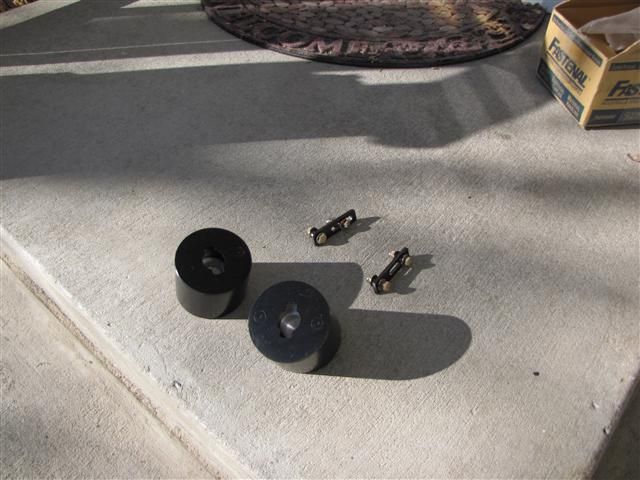
I also knew I wanted to retain the factory air suspension in the back, because I feel this would be an asset on an expedition vehicle. As long as I carry a spare air spring. The air suspension allows me to keep the vehicle level, even when the back of the Disco was loaded to the point of explosion. It also helps that I can raise the back of the car to give it a better departure angle. So this meant I wanted some spacer blocks for the back. Not a big ask, right? HA! After doing some reading on a Brit DII enthusiast's site, discovery2.co.uk, I tried going with ToddCo Suspensions out of Atlanta. I went on the ToddCo site and ordered a set of spacers. After ten days with no contact and nothing arriving at my door, I tried calling the company about fifty times and fired off a few emails. Nothing. So, I sent an email cancelling my order (which was promptly responded to), and went to another, very highly recommended manufacturer of Land Rover parts, RTE Fabrication. (rte-fab.com). This was both a good and bad decision. 

A few calls to RTE Fab and things were looking good. Their customer service was fantastic, and although they took quite a while to make my part (they were behind on other orders and I ordered during a rather busy time of the year), they were very good about explaining things and overall the experience was good. So, once I finally got all that crap together, I could go ahead and install the lift. This part was pretty straightforward.

I drove my Disco over to my friend Mitchell's house. He's just about the most mechanically inclined person I know, he's the best fabricator I've met, and he helps me out with a lot of the work I do. And best of all, he's FREE! So you'll be seeing a lot of him.


I got the car up on jack stands with the tires off, then Mitchell and I unbolted and removed the shock towers.


Once that was done, we popped the shock towers out, removed and replaced the old shocks, and installed the new springs, which I had just then discovered were the same length as the factory springs. I almost s**t my pants when I saw that, thinking they wouldn't lift the car at all. But then I saw the difference in the spring thicknesses and realized that it gets the lift from the increased spring rate. Okey doke, not a problem.

New shocks installed in the shock towers

The only clean parts under the damn thing

Mitchell putting the passenger's side back together

Once the front was put together, I pulled out of the garage, turned around, and backed in. Time to do the back. This is where things got complicated. Upon inspection of the air spring spacer kit I got, we noticed something amiss. It's difficult to explain, but basically the bolts that were supposed to hold it to the car were threaded into holes that weren't drilled at the correct angle into the stock. So they're made a bit wonky. But we managed to make them work, with a lot of drilling. It is for this reason that I DON'T recommend that anyone buy the RTE spacers. RTE makes awesome products, just not spacers. My suggestion is to buy ToddCo spacers from Lucky8 Off Road (lucky8llc.com). Their customer service is fantastic and they would act as a middleman for the better ToddCo parts. 

Spacers and height sensor relocation brackets

Up in the air

New air springs and spacers installed

Height sensor relocation brackets

After all that work, we aired the suspension back up a bit, reinstalled the tires, and took it off the jacks. And it was done!

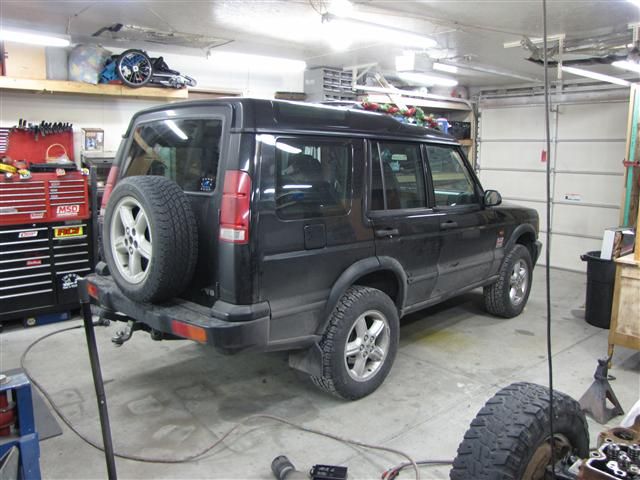
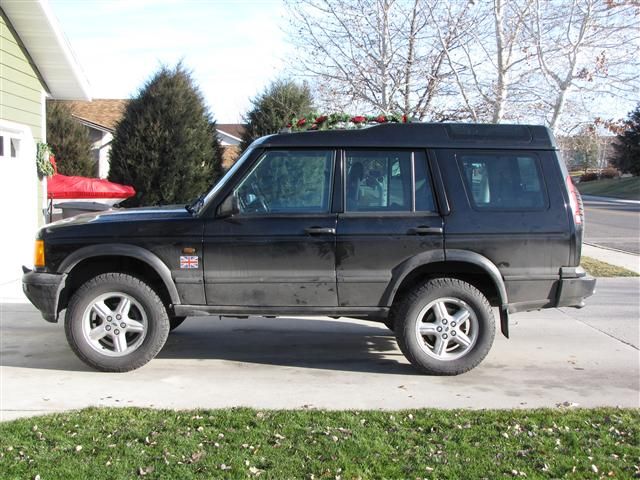
All installed and done

We then spent a few minutes adjusting the height sensors to level it and and BAM! Done. I think it looks fantastic, and it drives even better than it did before, which is amazing because of the Active Cornering system that came on it. And there it is. I was able to net 2 1/4" of lift overall. 


Wednesday, January 9, 2013

The Disco: Intro

So I thought I'd take the time to talk about my vehicle/ongoing project/expedition rig.

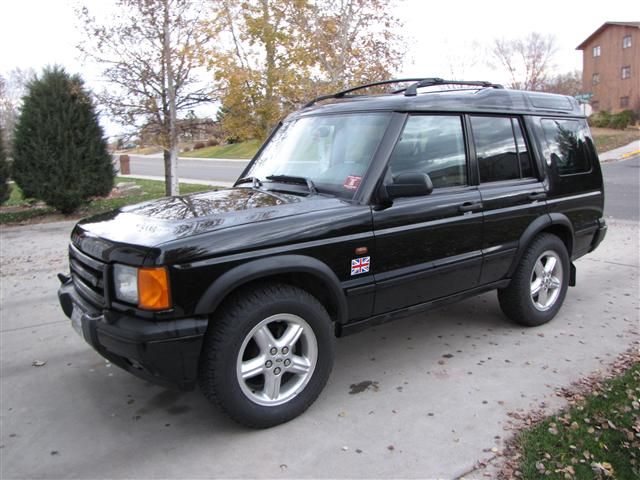
Basically stock, with just bigger tires

At first, I was in the same camp as the majority of Montana offroaders. I had a big pickup truck on 35's with  a mean engine I built myself. I had fun with that... for awhile. Then the logistics of the vehicle hit me in full as I started wanting to do overland travel.

  • It was horribly unreliable. Once I even broke down about fifty yards from my driveway. 
  • It was a gas-guzzling pig, struggling at the best of times to get over 6 mpg.
  • There was no space for people, being only a single cab pickup.
  • There was no interior space for cargo, although this could have been rectified by adding a topper.
  • The ride was awful.
  • The suspension flex was terrible.

So, I started looking for something that was more practical. I had always liked that safari style look that I now know is called overland. So I wanted something like that. At first, I wanted something like a Nissan Frontier or Xterra, or maybe a Toyota Tacoma or Land Cruiser, but I soon saw some problems with them. Xterras and Frontiers are plentiful, and the prices aren't too bad, but they're much too small to be all that useful. A Frontier would have been the better option there, but the options near me were a little sparse. And again, they're too small. A Toyota Tacoma or Toyota Land Cruiser would have been even better, and they're not hard to find, but the price was a little excessive. My main focus, though, was a Land Rover. I knew they had a few reliability concerns, but I'm not afraid to work on things myself, and after some research, I found that those reliability problems were mostly over-inflated. To me, the quintessential "safari" vehicle was a Land Rover. My favorite was, and is, the Land Rover Discovery. And it has a lot going for it. 

  • Their offroad prowess is undeniable.
  • On the road, they're very comfortable. 
  • They have a stylish look that looks good and at home anywhere. 
  • They have short wheelbases. 
  • They sport solid axle, coil sprung suspensions that are tough and flexible offroad. 

So the Discovery makes a great overland rig. A buddy found a crackin' 2001 Disco II with 100,000 miles on it for a reasonable price. And, as a plus, it's the top of the line SE7 trim, which has real leather heated seats, two sunroofs (yes, two), the factory rear air suspension, seven seats, as well as some other nice creature comforts. It was driven by a woman who took very good care of it and babied it for most of its life. So I bought it. That was a great decision, as I now have a good platform for an expedition rig. So the next step was to set about modifying it.

Being an overland rig, it has some unique needs, which I broke down into five categories:

  1. Off road suspension.
  2. Traction.
  3. Protection.
  4. Storage.
  5. Expedition gear.

Most of these will get tackled in a rather haphazard manner, because that just seems to be the way I do things. =)